


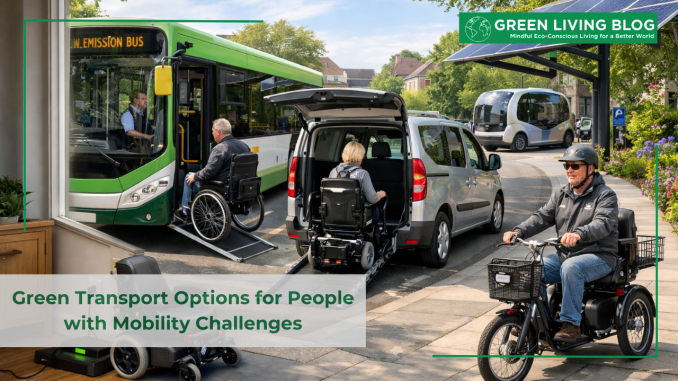
Living with mobility challenges should not exclude anyone from making environmentally responsible transport choices.
Access, independence, and sustainability often intersect in complex ways. Transport decisions influence daily routines, long-term costs, and environmental impact at the same time. For many people, the challenge lies in balancing accessibility needs with realistic green alternatives.
Transport sustainability does not depend solely on new technology. It also depends on how existing resources are used, adapted, and extended.
For people with mobility challenges, greener transport often means making informed choices within real physical and logistical constraints rather than following idealised models.
The Growing Need for Accessible and Sustainable Transport
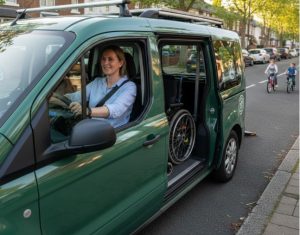
Across the UK, many people rely on adapted vehicles to maintain independence. These vehicles are often larger and heavier than standard cars due to ramps, lowered floors, and reinforced interiors. This design can increase fuel consumption, which raises concerns about emissions and long-term environmental impact.
As the UK moves towards net-zero targets, accessibility and sustainability are increasingly discussed together. People with mobility needs face the same environmental responsibilities as everyone else, yet they require solutions that respect physical realities. Extending the usable life of existing vehicles plays a meaningful role in reducing manufacturing demand and material waste. In this context, affordable used WAVs provide a practical balance between accessibility and reduced environmental impact without requiring new production.
Used vehicles limit the need for additional raw materials, factory emissions, and transport associated with new builds. When adaptations already exist, reusing them avoids duplication and supports more responsible consumption patterns.
Understanding Sustainability Beyond New Technology
Green transport is often framed around electric vehicles, cycling, or public networks. For people with mobility challenges, sustainability takes a broader form. It includes vehicle longevity, energy efficiency, and reduced resource extraction rather than single-mode solutions.
Choosing a used adapted vehicle supports sustainability by prioritising reuse. Even when powered by petrol or diesel, a pre-owned vehicle may carry a lower overall environmental cost than a newly manufactured alternative. Lifecycle impact matters as much as tailpipe emissions when assessing greener transport decisions.
For individuals managing mobility limitations, independence often relies on personal transport. Selecting options that reduce environmental pressure while maintaining reliability allows people to align everyday travel with broader sustainability goals.
Electric and Hybrid Wheelchair Accessible Vehicles
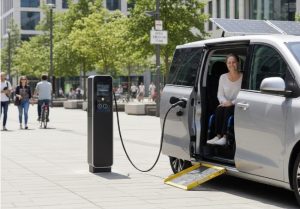
Electric wheelchair accessible vehicles remain limited in number but continue to expand slowly across the UK market, reflecting wider trends in electric vehicle adoption in the Uk. Some manufacturers now offer fully electric or hybrid adapted models, both new and pre-owned. These vehicles reduce exhaust emissions during operation and contribute to quieter urban environments.
Electric WAVs support lower-carbon travel when charged using renewable electricity. However, range limitations, charging access, and vehicle availability still affect practicality. Urban areas offer better charging coverage, while rural regions require more careful planning.
Hybrid options offer a transitional solution. They reduce fuel use without relying entirely on charging infrastructure. For many people, hybrid WAVs provide a workable balance between emissions reduction and everyday usability.
Greener Choices Through Retrofitting
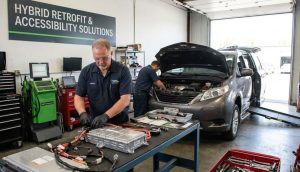
Existing wheelchair accessible vehicles can sometimes be upgraded to improve environmental performance. Retrofitting allows owners to retain familiar adaptations while reducing fuel consumption or emissions. Hybrid conversions and efficiency upgrades offer incremental improvements without replacing the entire vehicle.
The retrofit process requires specialist assessment. Vehicle weight, structural adaptations, and power requirements must align with conversion systems. Proper testing ensures ramps, restraints, and safety features remain fully functional after modification.
Funding options change regularly. Some national schemes now prioritise fleet updates that support greener mobility solutions, while local authorities may align grants with wider sustainability targets for accessible transport. Careful review of eligibility criteria remains essential before committing to retrofitting or vehicle replacement decisions.
Public Transport and Low-Emission Accessibility
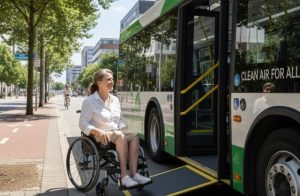
Public transport improvements play a role in greener mobility for those able to use them. Low-emission buses with level boarding and designated wheelchair spaces operate in many UK cities, supported by wider investment in low emission public transport. Electric and hybrid fleets reduce emissions while supporting accessible travel.
Rail networks continue to improve step-free access, though coverage remains uneven. Infrastructure upgrades focus on both accessibility and carbon reduction. Digital planning tools now help identify accessible routes and lower-emission services across urban areas.
Community transport schemes also contribute. Electric accessible minibuses support passengers who cannot use standard services while reducing local air pollution. These schemes demonstrate how sustainability and accessibility can coexist when planning focuses on real needs.
Micro-Mobility and Adapted Low-Emission Options
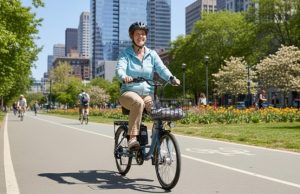
For people with partial mobility, adapted electric cycles and tricycles can complement wider shared transport accessibility by offering low-emission options for short, local journeys. These solutions reduce reliance on full vehicles while supporting independence, smoother transitions between transport modes, and more inclusive participation in everyday travel.
Assessment and proper fitting remain essential. Terrain, strength, and balance influence suitability. When matched correctly, adapted cycles offer both environmental and health benefits without compromising safety.
Modern mobility aids also incorporate greener technology. Energy-efficient motors, improved batteries, and regenerative features reduce power consumption. Manufacturers now publish clearer performance data, allowing informed comparisons between models.
Planning Transitions Between Home and Transport

Sustainable travel and commuting relies on smooth transitions between home environments and transport systems. Equipment preparation, charging routines, and route planning influence daily feasibility. Smart planning tools increasingly support this process by integrating accessibility and transport data.
Portable mobility equipment now includes recycled materials and improved battery efficiency. These features reduce environmental impact over time and support longer equipment lifespans. Transparent product specifications help buyers weigh sustainability alongside functionality.
As technology evolves, integration between home accessibility and transport planning continues to improve. These developments reduce friction and support consistent use of greener transport options.
Future Directions in Accessible Green Transport
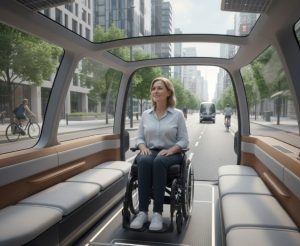
Emerging technologies continue to shape future possibilities in accessible green transport. Electric autonomous vehicles with built-in accessibility features aim to support door-to-door mobility without reliance on drivers, reflecting broader shifts in future urban mobility models that prioritise inclusion alongside sustainability. Although still in development, these systems signal long-term commitments to reducing emissions while expanding independent travel options for people with mobility challenges.
Hydrogen fuel cell technology is also under evaluation for larger accessible vehicles. Its longer range and faster refuelling may suit community transport and high-demand services where battery systems remain limited.
Urban planning increasingly incorporates universal design alongside sustainability goals. Charging points, accessible routes, and integrated hubs reflect a shift towards inclusive green infrastructure.
Balancing Independence and Environmental Responsibility
Sustainable transport for people with mobility challenges requires practical balance rather than idealised solutions. Independence, reliability, and environmental responsibility must coexist within real-world constraints.
When transport systems recognise accessibility as a core requirement rather than an exception, greener choices become more realistic. Sustainable mobility remains achievable when solutions respect lived experience, physical needs, and environmental responsibility at the same time.

Author Profile

- Passionate content creator, contributor, freelance writer and content marketing allrounder.