


Empowering people, not replacing them
When people hear about AI in agriculture, they often ask: Will it replace farmers? Our answer is unequivocal: no. Perhaps the most important principle in adopting AI on farms is this: it should make workers more valuable.
Farming is deeply human work. It requires judgment, intuition, and relationships with the land that cannot be replicated by algorithms. What AI can do is reduce repetitive or low-value tasks such as manual data entry, monitoring weather alerts, or walking hundreds of acres to check irrigation efficiency.
By handling these tasks, AI frees our team to focus on higher-level work: engaging with tenants, innovating on crop rotations, and implementing regenerative practices. New tools also make it easier for farmers to contribute their knowledge — taking a photo, dictating a note, or entering a quick update into a mobile app that instantly feeds into the broader system. Over time, this iterative loop of human judgment plus AI-driven insights makes our operations both more efficient and more resilient.
Building for the long term
One of the greatest risks with new technology is rushing in too quickly. AI is evolving rapidly, and the tools available today may look entirely different five years from now. That’s why Farmland LP is building our AI adoption iteratively. Each project is designed to deliver value now while laying the groundwork for future systems.
Take water management as an example. On our farms, water is one of the most valuable resources. In California, senior water rights dating back to the 1950’s give us secure access to irrigation, but responsible stewardship is essential. AI-enabled irrigation systems can already optimize when and how much water to apply. Over time, as models ingest more data on soil health, weather, and plant responses, these systems will become increasingly precise, ensuring we use every drop wisely.
Another example is crop planning. AI can analyze decades of weather, soil, and market data to suggest optimal rotations and planting schedules. But final decisions remain with our agronomists and farm managers, who factor in experience, tenant needs, and long-term soil health. The point is not to hand control over to machines, it’s to equip our team with better information to make sustainable decisions.
AI and sustainability: the double bottom line
Thoughtful AI adoption has the potential to accelerate environmental gains across agriculture. Among the most promising benefits:

• Soil Health: AI-powered monitoring allows us to reduce chemical inputs and tailor organic amendments more precisely, supporting richer microbial activity in the soil.
• Water Conservation: By detecting stress earlier, AI systems help us avoid overwatering and reduce the energy required to pump and distribute water.
• Carbon Sequestration: Healthier soils store more carbon. AI can track and optimize practices like cover cropping that increase sequestration rates.
• Biodiversity: Early detection of pests and diseases allows for targeted, organic interventions that protect beneficial insects and surrounding habitats.
• Transparency: Unified reporting platforms make it possible to share real-time impact metrics with investors and stakeholders, building trust and accountability.
Each of these outcomes supports what many farmers already know intuitively: what’s good for the environment is often good for long-term profitability.
Leading with caution and confidence
AI is often portrayed in extremes: either as a panacea that will solve all problems, or as a threat that displaces workers and degrades society. Our experience suggests a different path. When applied thoughtfully, AI is neither savior nor threat, but instead a practical tool that can help us farm smarter and steward the land more effectively.
Farmland LP’s mission has always been to demonstrate that regenerative agriculture is not only better for the planet, but also more profitable than chemical-dependent farming. AI is now a big part of that toolkit. By pairing our talented team with exceptional farmland and best-in-class technology — including our partnership with Microsoft — we are building a model for how agriculture can feed a growing population while restoring the ecosystems on which farming depends.
This is not about moving fast and breaking things. It is about moving steadily and building things that last. For the farmers we work with, the investors who support us, and the communities that rely on healthy food, that difference matters.
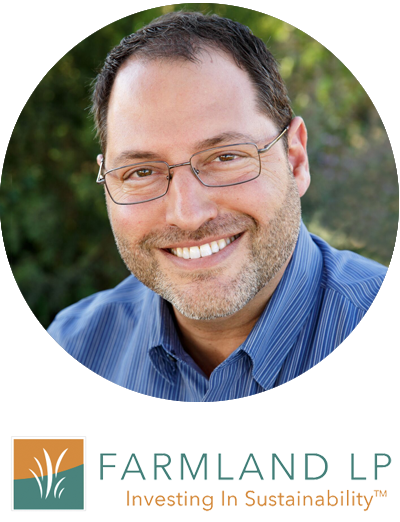
Article by Craig Wichner, Founder & Managing Partner, Farmland LP
Craig is responsible for day-to-day management, business strategy and all investment activity. An experienced technology and real estate investor, Craig has helped build numerous companies over the past 30 years. But it was his work on California farms as a teenager that ultimately inspired him to start Farmland LP. Craig’s mission has not changed since day one – prove that regenerative farming is more profitable and maximizes returns for investors. Craig strives to ensure that investors and consumers can look beyond misleading labels and support beneficial farming practices. His efforts were recognized in 2021, when Farmland LP achieved the highest sustainability rating among 10,000+ global corporations reviewed by HIP (Human Impact +Profit) Investor. Craig has a Bachelor of Science in Biochemistry and Molecular Biology, with a minor in Economics, from the University of California, San Diego.
Article sources:
• https://www.gao.gov/products/gao-24-105962#:~:text=Promotion%20and%20outreach%20to%20farmers