


Our latest State of the Sustainability Profession report told a tale of two companies: those staying the course and those in retreat. The good news? More are staying the course: 46 percent of companies have increased budgets and headcount in sustainability over the last two years, 25 percent have cut back and the rest are keeping them roughly unchanged.
Within these companies, two very different experiences for sustainability professionals are also playing out at once: those who report they are thriving, and those who are disillusioned. Not surprisingly, the most satisfied professionals work at companies that are leaning in on sustainability.
As part of the survey that underpins the report, we asked the following questions to gauge how sustainability professionals are doing during this turbulent moment:
- Over the past two years, how has your level of professional fulfillment in your sustainability career changed?
- Here are some words sustainability professionals have used to describe their feelings about the profession: confident, insecure, optimistic, pessimistic, discouraged, resolved, angry, accepting, happy, sad, confused. Which best describes how you feel?
Of more than 1,000 respondents who answered at least one of these questions, about equal numbers are feeling satisfied and unsatisfied. Slightly more than 40 percent reported high satisfaction, meaning they gave at least one positive signal (more fulfilled or only positive emotions) without contradicting it on the other question. Another 40 percent reported low satisfaction; 20 percent landed in the middle.
When we dug into the data, we found three factors clearly predicted satisfaction – and they’re all things you can test for, whether you’re deciding to stay in your current role, weighing your next move or looking to get into sustainability for the first time.
Here is what unites the group of professionals who are thriving today:
The strongest predictor? Sustainability communications
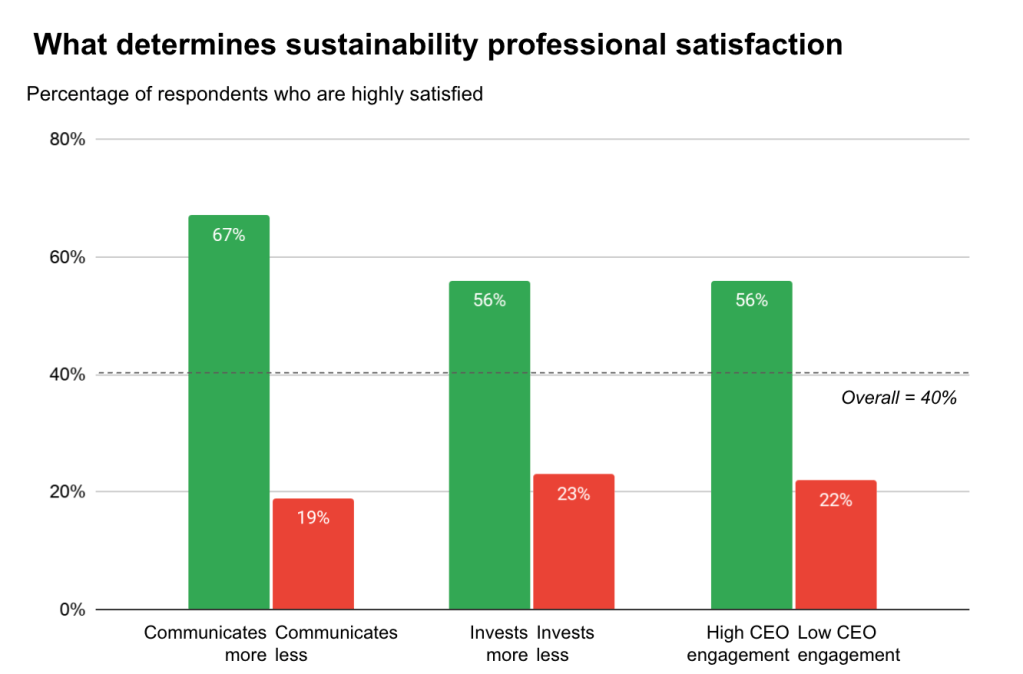
How a company communicates about sustainability is the biggest predictor of professional satisfaction. Our study found professionals at companies communicating more about sustainability than two years ago are 3.5x more likely to be highly satisfied (67 percent) than those at companies communicating less (19 percent).
That’s especially important because professionals told us that even as their companies continue to invest in sustainability, they are communicating about it substantially less: 63 percent have either scaled back their communications about sustainability in the last two years, or rethought how they talk about it.
While companies that pay lip service to sustainability with no real underlying action can be demoralizing to work for, public commitments send a signal about what companies stand for and help to hold them accountable.
“We have tied sustainability to our brand and culture for so long that we weren’t going to back off of it just because political winds shifted,” wrote a sustainability director at a U.S. building supply company.
When resources come under pressure, companies tend to cut back to deliver on only what they have committed to publicly.
“Due to financial constraints, we have had limited resources to pursue more progressive voluntary projects and ideas,” wrote a head of environmental affairs at a global pharmaceutical company. “We have done what is needed to continue delivering on our public targets and meet compliance standards.”
Another key indicator? Budgets
The next strongest predictor of professional satisfaction is sustainability investment. When the sustainability team’s budget increased in the last two years, 56 percent of professionals were highly satisfied. When the budget was cut, only 23 percent were. If your company has increased spending on sustainability outside of the core team, you are 2.6x more likely to be satisfied.
When asked about the reasons behind increases in sustainability spending, respondents often cited the financial performance of the company itself. One respondent said: “The company is growing overall.” Another said: “The company is profitable.”
Financial investment in sustainability was a more significant predictor of satisfaction than other types of investment, like headcount.
An engaged CEO matters
At companies where the CEO is openly engaged with sustainability (gets a score of 6 or 7 on a scale of 1-7), 56 percent of professionals are highly satisfied. Where the CEO is dismissive or uninterested, only 22 percent are. Sustainability professionals who report directly to the CEO are about 1.5x more likely to be highly satisfied as those who report elsewhere.
Recent changes in CEO have been disruptive for sustainability teams.
“Our previous CEO was very engaged, and it was a priority,” wrote a sustainability director at a medium-sized firm. “With the new CEO, the priorities shifted, therefore the team is back to making a business case for sustainability as a function of the business.”
For sustainability professionals, seniority does not predict satisfaction. There are just as many highly satisfied professionals at lower levels as there are at higher levels. Larger companies skew slightly more toward dissatisfaction, but the effect is small.
The ‘job satisfaction’ checklist
If you’re weighing your next move at a new organization or deciding whether to stay in your current role, the data offers some key things to learn more about:
- Look for companies that communicate publicly about sustainability initiatives, including stating public targets and continuing to update against them. This might include press releases, descriptions on websites, or inclusion in financial filings.
- Ask if sustainability budgets and headcount have grown in the past year and by how much. If this data is unavailable, look at overall company growth and profitability.
- See if the CEO has spoken publicly about sustainability in media interviews or earnings calls. Ask if the CEO meets regularly with sustainability leadership.
These three signals matter more than what your title is and where the team sits on the org chart.
One highly-satisfied survey respondent, a senior corporate responsibility specialist at a U.S. utility company, described what it feels like to have a role at the right kind of organization, even in 2026:
“I feel that my work now is more important than ever, and every win feels bigger than it ever did,” she wrote. “I am lucky to work in a state and for a company where we are continuing to invest and push forward, and I know that at some point – the national momentum and pendulum will swing forward again, and we will be ready to meet that moment.”