

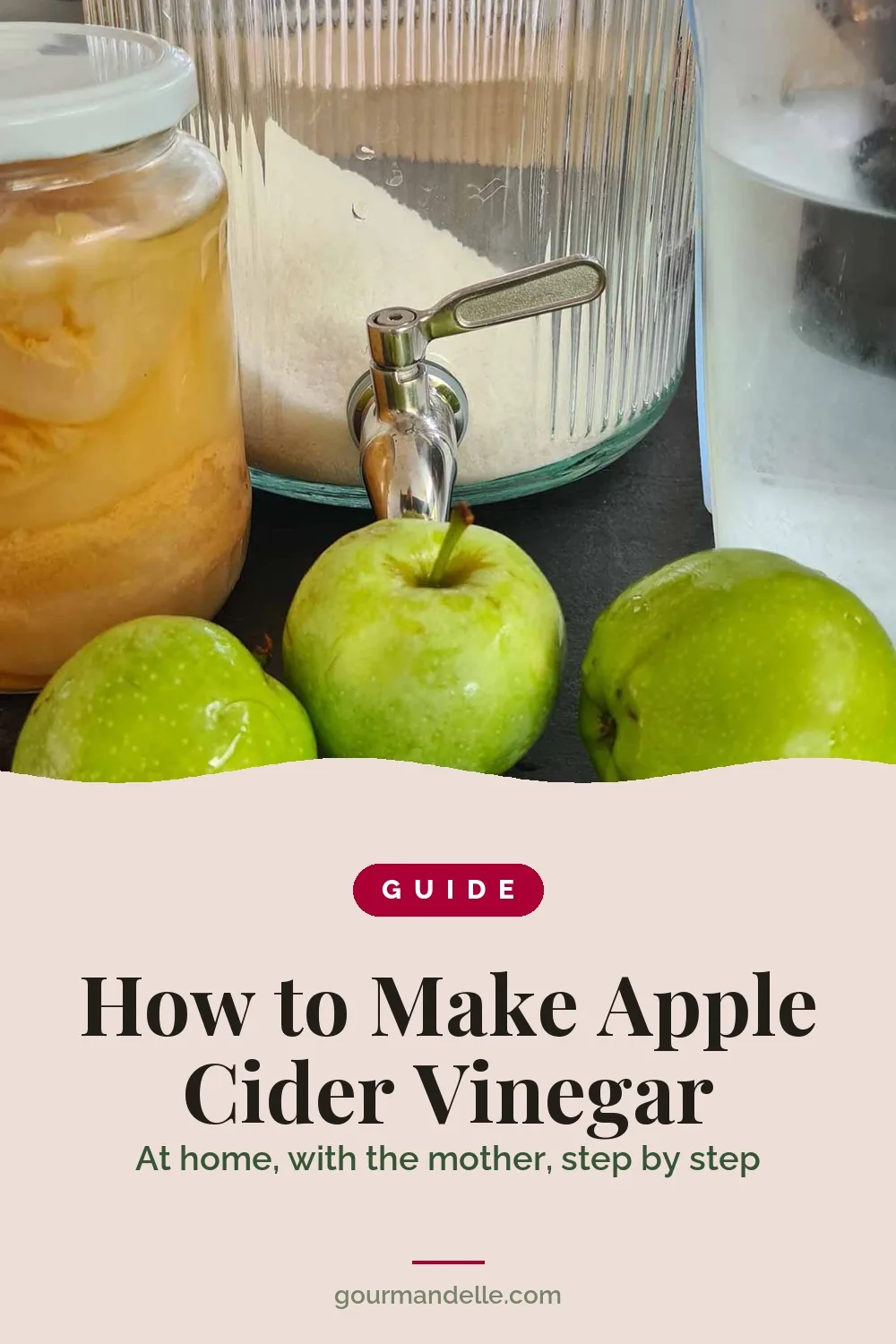
Here is how to make apple cider vinegar at home from whole apples, a little sugar, water and a starter: either a bottle of raw vinegar with the mother, or the mother left over from your last batch. The method is two slow fermentations in one jar, about 20 minutes of real work and a couple of months of patience. Below you will find my exact quantities for an 8-liter jar, a week-by-week timeline, how to tell the mother apart from mold, how strong homemade vinegar really is, and how I use it in the kitchen, in a glass of water and on my hair.
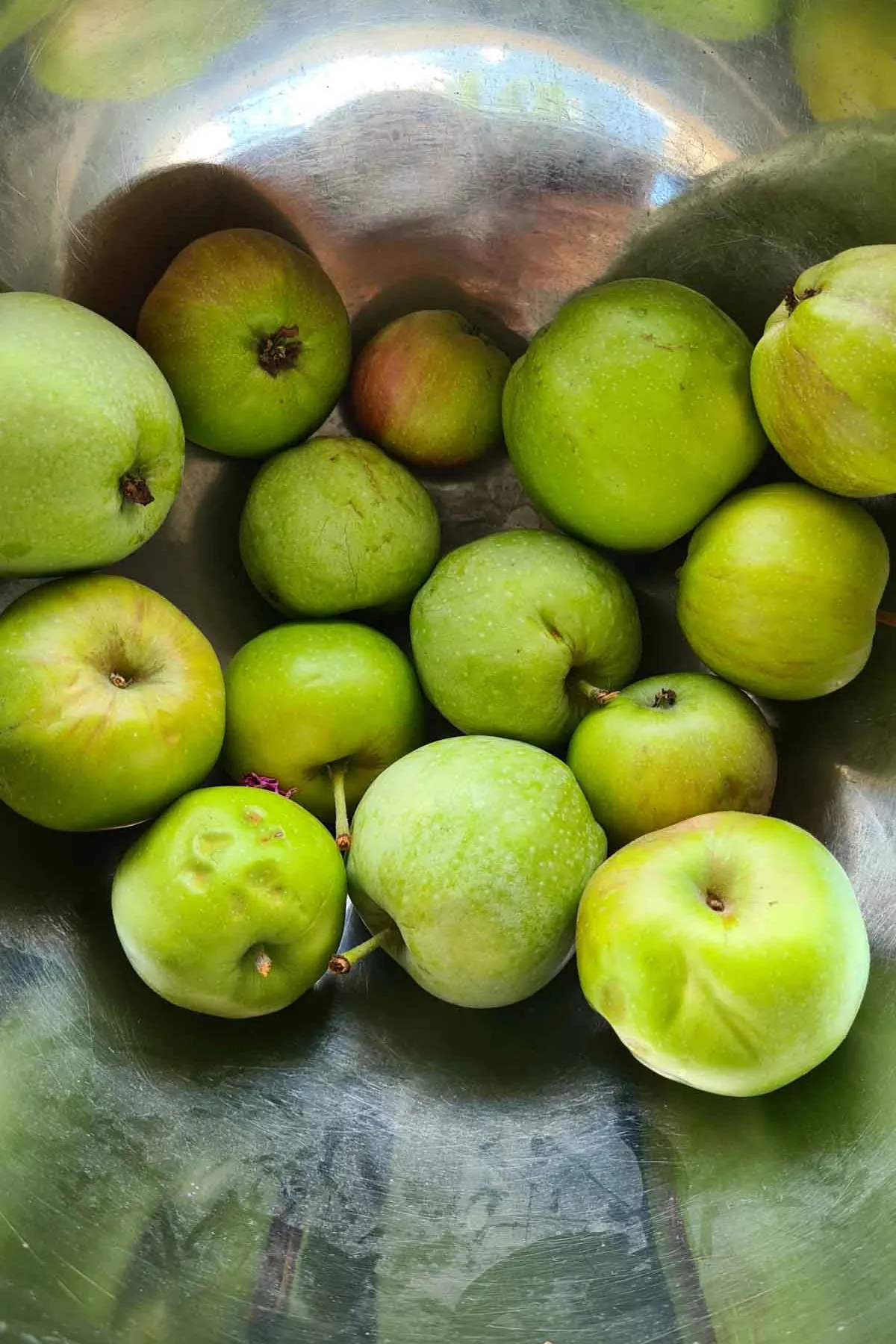
The apples come from our garden: small, green, a little bruised, and far more than we can eat. The first year, I started my vinegar with a store-bought bottle of raw apple cider vinegar with the mother (De Nigris, the brand I trust). The second year I did not buy anything: a thick, rubbery disc had grown on top of the first batch, a lot like a kombucha SCOBY, and I had kept it in the fridge in a jar of its own vinegar, feeding it a spoon of sugar now and then. With that mother, the new batch started bubbling within days and was ready much sooner.
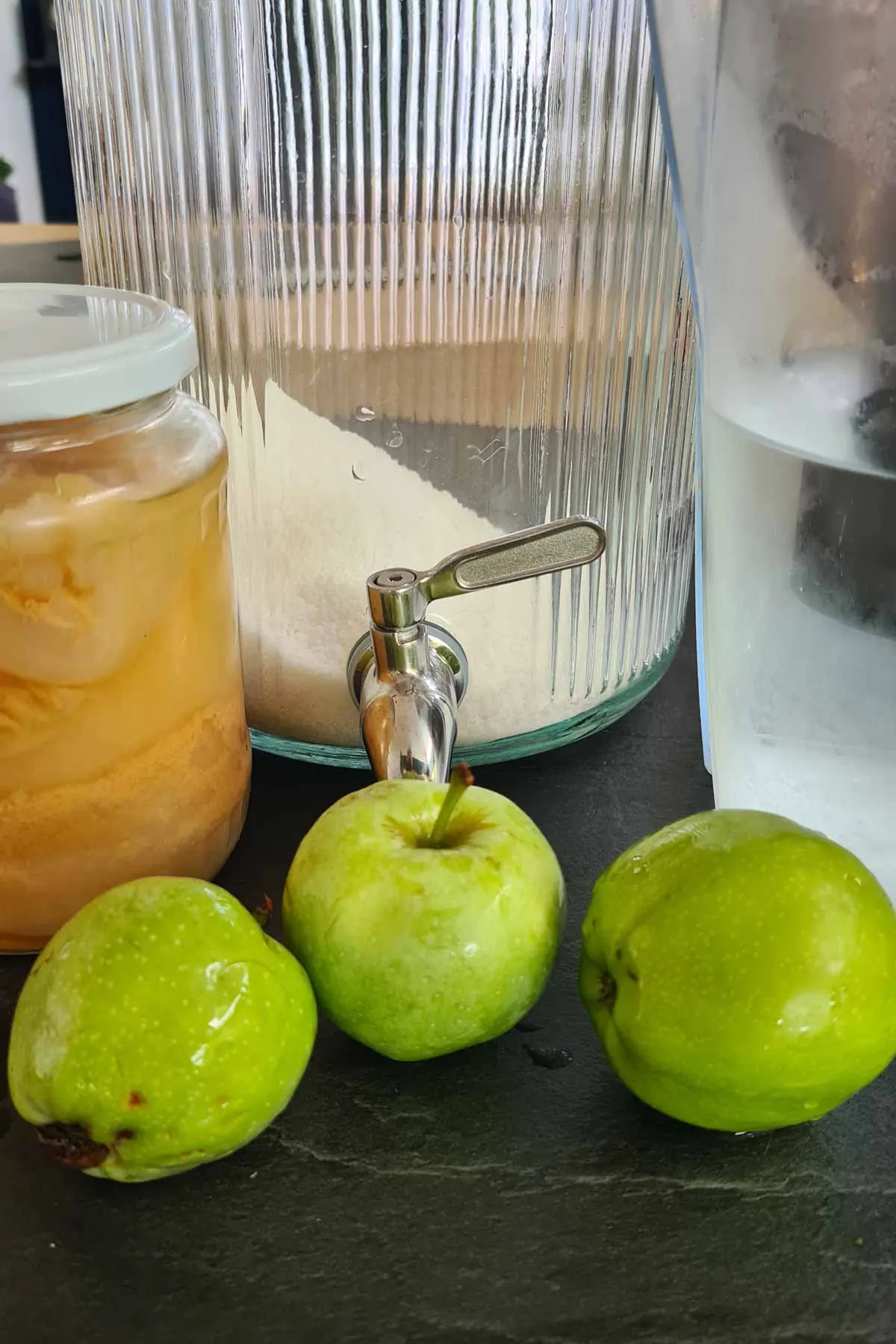
Table of Contents
What You Need for an 8-Liter Jar
This is the batch I make in my 8-liter glass dispenser. The jar is filled only about three quarters of the way, because the apples need room and the bacteria that turn alcohol into vinegar need air.
- 2.5 kg (5 1/2 lb) apples, any kind, washed and cut into quarters, with the peel, cores and seeds left in. Garden apples, windfalls and slightly bruised ones are fine; cut away anything rotten or moldy.
- 3 liters (12 1/2 cups) water, filtered, or boiled and cooled. Chlorine in tap water can slow the yeast down.
- 200 g (1 cup) sugar. I use plain white sugar; it feeds the yeast and disappears as the vinegar forms.
- A starter: 500 ml (2 cups) of raw, unfiltered apple cider vinegar with the mother, or a palm-sized mother plus 300-400 ml of the vinegar it lives in.
- A wide glass jar or a glass dispenser with a stainless steel tap, a wooden spoon, a clean cotton towel or a few layers of cheesecloth, and a rubber band.
It makes roughly 2.5 liters of vinegar. You can halve everything for a 4-liter jar.
How Homemade Apple Cider Vinegar Works
Vinegar is made in two steps, and it helps to know them, because each one needs something different.
- Step 1, yeast: wild yeasts from the apple skins (and from your starter) eat the sugar and turn it into alcohol. This is the bubbly, cider-smelling stage. It likes stirring, which keeps the fruit wet and moves air around.
- Step 2, acetic acid bacteria: bacteria such as Acetobacter and Komagataeibacter turn that alcohol into acetic acid, the sour part of vinegar. They need oxygen and work at the surface, so this stage likes a wide jar, a breathable cover and no disturbing. They are happiest at 25-30 °C; a cooler room just means a slower batch.
Why add sugar if apples are already sweet? Because water dilutes them. Apples have about 10 g of sugar per 100 g, and once they are covered in water there is not enough to reach a proper vinegar strength. Green summer apples, like mine, have even less. The sugar is what lets the vinegar get sour enough, and it is used up along the way.
The starter matters too. Adding raw vinegar makes the liquid acidic from day one, which shortens the sweet, unprotected stage when mold could get a foothold, and it brings the vinegar bacteria straight in, so you do not have to wait for them to show up on their own.
What Is the Vinegar Mother (and Is It Like a Kombucha SCOBY)?
The vinegar mother is the slippery, jelly-like disc that grows on top of vinegar. It is a mat of cellulose made by the vinegar bacteria themselves, mostly Komagataeibacter xylinus, with the bacteria living inside it. The cloudy strands you see at the bottom of a bottle of unfiltered vinegar are the same thing, just younger.
It looks a lot like a kombucha SCOBY, and that is no coincidence: a SCOBY is also a cellulose mat made by the same family of bacteria. The difference is that a SCOBY also holds a lot of yeast. Mine came from vinegar, not kombucha; if you want to read about the tea version, I have a whole guide to homemade kombucha.
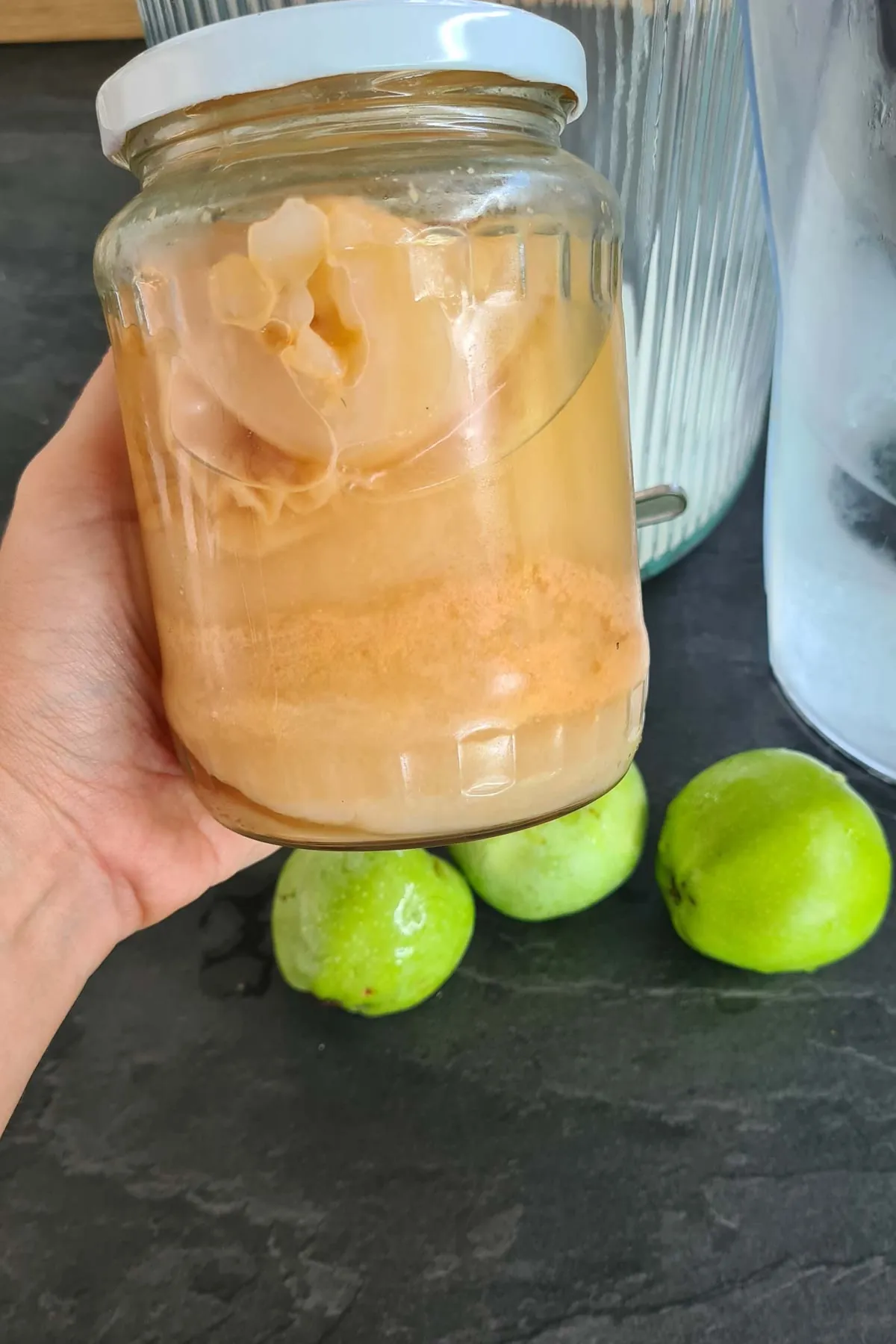
Do you need a mother to make vinegar? No. A splash of raw vinegar is enough, and a new mother forms on top of every batch, so you never have to buy one. You also do not need a special recipe to make a vinegar mother: leave a batch alone in a warm, quiet spot and it grows by itself. A mother that sinks is fine, too. A new one simply forms on the surface.
Between seasons, I keep mine in a closed jar in the fridge, covered with its own vinegar, and once in a while I add a teaspoon of sugar. Extension services say both ways work: in the fridge, or at room temperature in a little of its own vinegar.
Store-Bought Raw Vinegar or a Mother: How to Start
Year one, with a bottle: buy an apple cider vinegar that says raw, unfiltered and unpasteurized, or with the mother, on the label. A clear, filtered vinegar does not work as a starter, because it has been filtered and usually pasteurized, so the live bacteria are gone. Shake the bottle so the cloudy sediment goes in, and pour in the whole 500 ml.
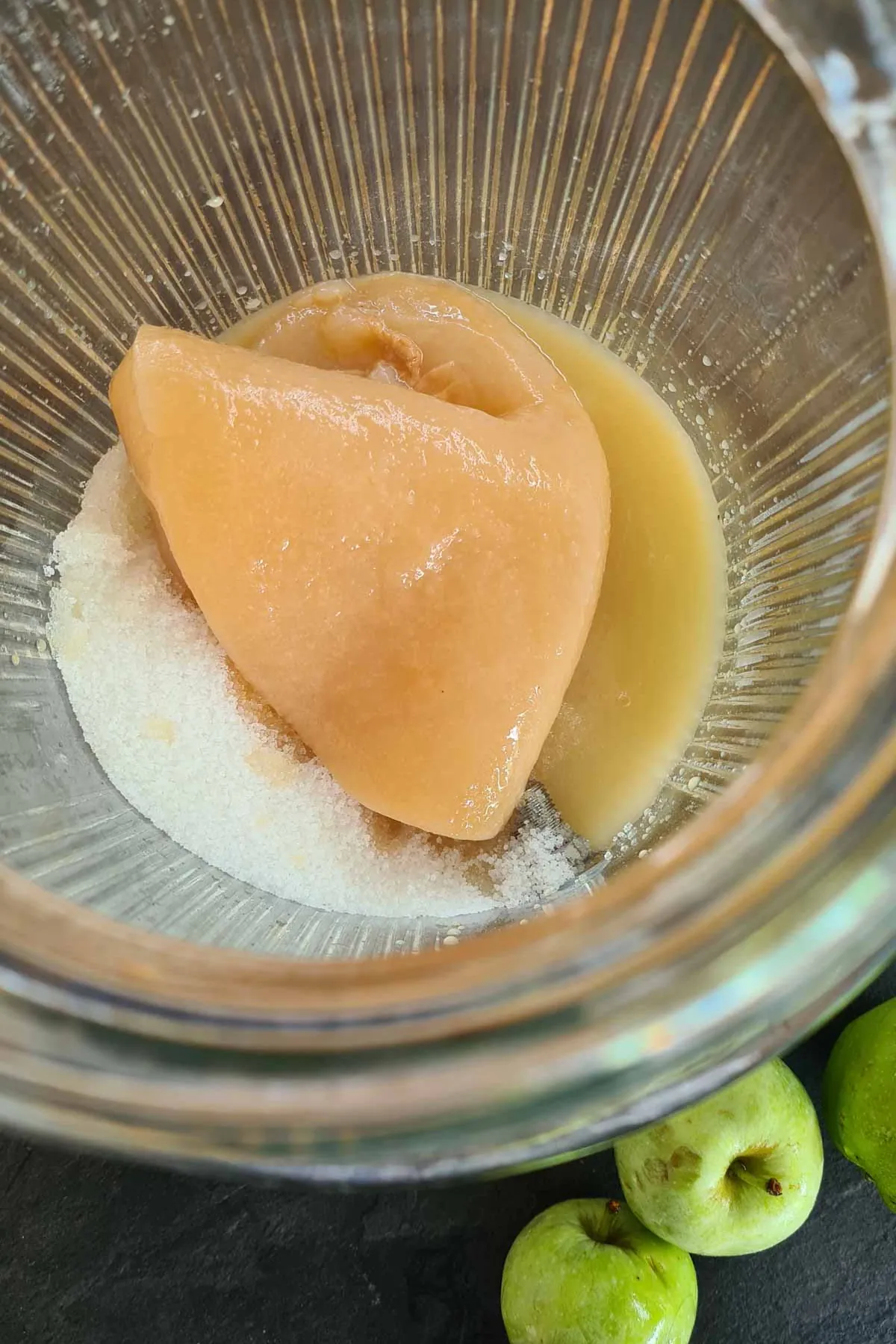
Year two and after, with your own mother: put the mother in the jar together with the vinegar it was kept in. Mine was about the size of my palm and came with 300-400 ml of liquid. A batch started this way bubbles sooner and turns sour faster, because the bacteria are already there in large numbers.
Step by Step: My Week-by-Week Timeline
These times are for a cool kitchen, out of the sun. Mine sits on a shady shelf, and in a warmer room everything goes faster.
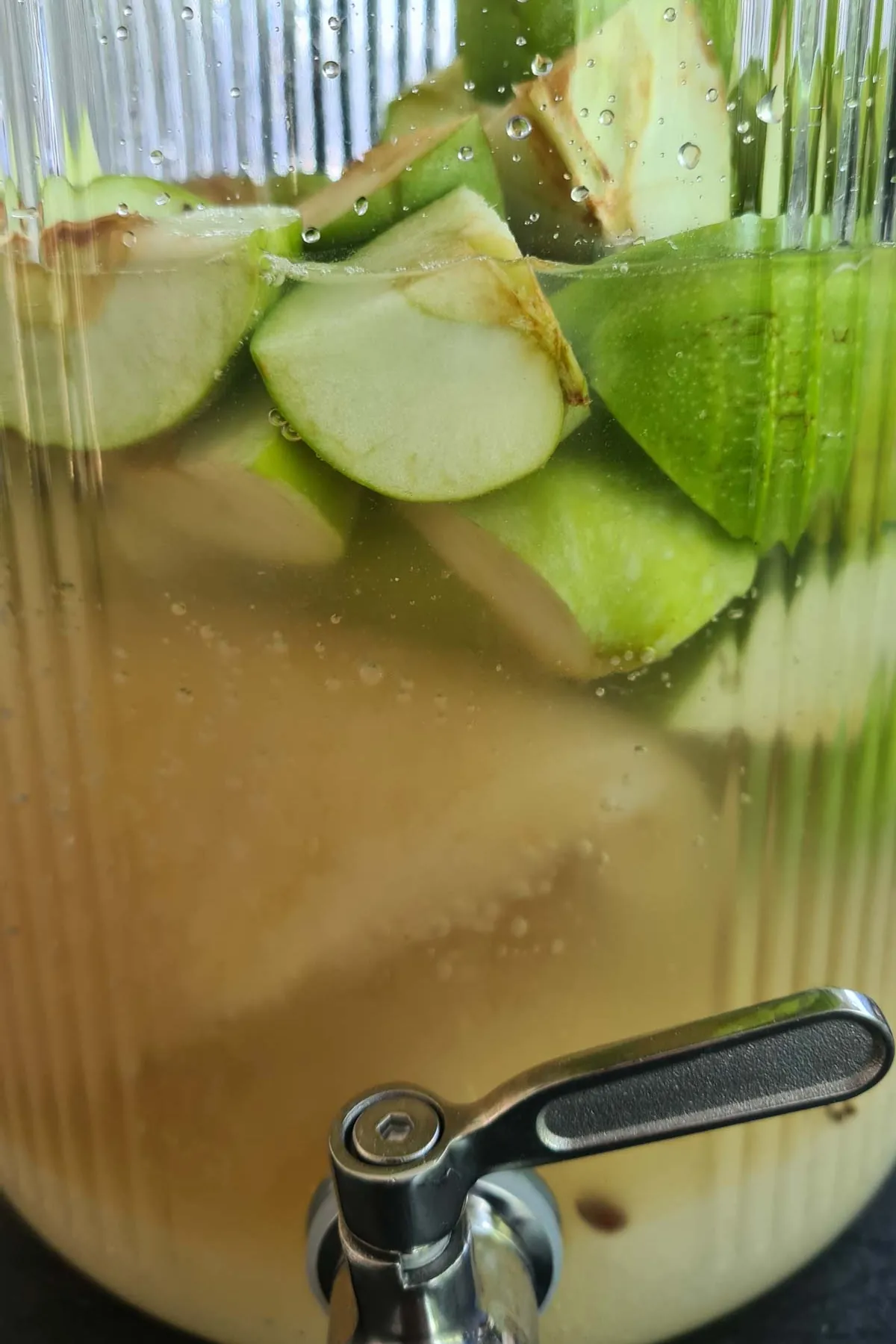
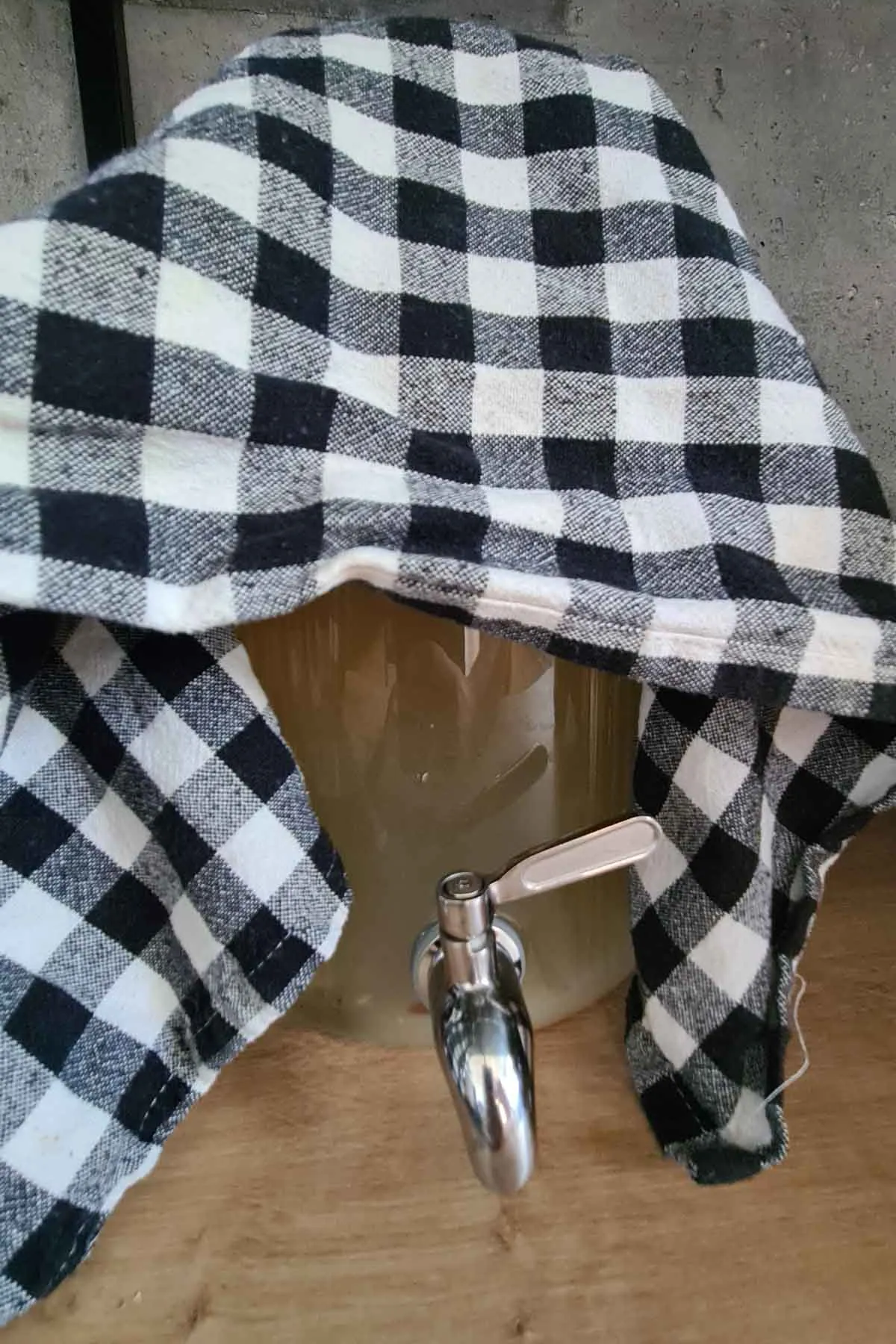
- Day 1: put the sugar and the starter (or the mother with its liquid) in the clean jar, add the apples, then pour in the water and stir until the sugar dissolves. The apples should be covered; they float at first, so press them down. Cover with a towel and a rubber band.
- Weeks 1 to 3: stir every day with a wooden spoon and push the apples back under the liquid. You will see bubbles and smell something like cider. This is the yeast at work.
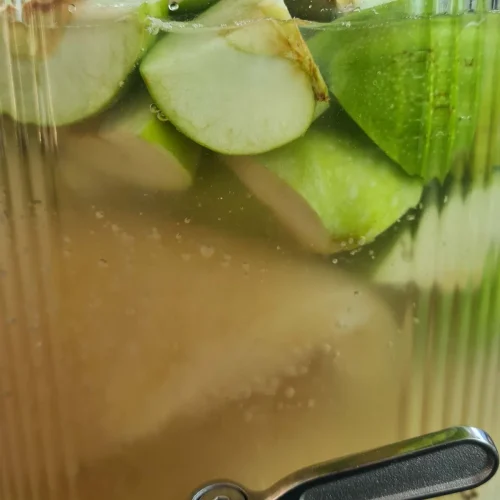
- Weeks 3 to 4: the bubbling slows and the apples start to sink. If this is your first batch, strain the apples out now: it is the safest moment, because fruit sticking out of the liquid is where mold starts. I leave mine in until the end, but with a big mother in the jar, the liquid turns sour quickly.
- From week 4: stop stirring and leave the jar alone, so the bacteria can work at the surface. A thin, pale film forms on top and slowly thickens into a new mother.
- From week 6 to 8: taste a little from the tap (or with a straw). It is ready when it smells and tastes clearly of vinegar, with no sweetness and no alcohol left. In my cool kitchen, it took a couple of months; give it more time if it still tastes like cider.
- Finishing: strain through cheesecloth, pour into clean glass bottles and keep the new mother for next year.
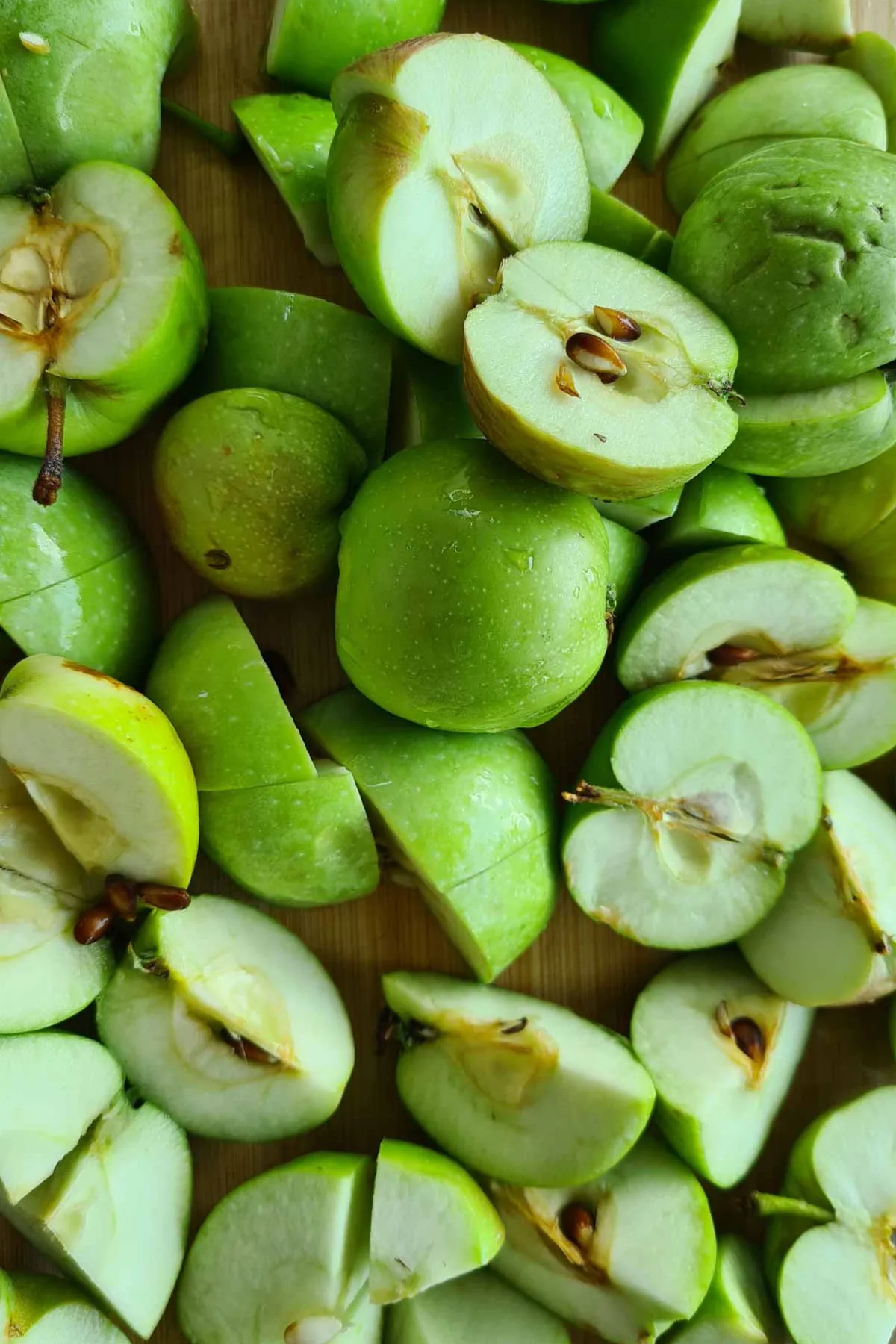
If you are baking a pie, you can use the peels and cores instead of whole apples. Apple scrap vinegar works the same way, with the same ratio of fruit, water and sugar by weight.
Mold, Kahm Yeast or a New Mother?
This is the question everyone asks the first time, so here is how to tell them apart.
| What you see | What it is | What to do |
|---|---|---|
| A smooth, wet, jelly-like layer, cream or tan, sometimes with holes or folds | A new vinegar mother | Nothing. It is a good sign. |
| A flat, dull white film, sometimes wrinkled, with no fuzz | Kahm yeast, harmless but not pretty | Skim it off and keep the apples under the liquid. |
| Fuzzy, dry spots, green, blue, black or pink | Mold | Throw the whole batch away and wash the jar well. |
| Brown strings or blobs floating in the liquid | Young mother or yeast sediment | Normal. They stay behind when you strain. |
A few other things you might notice:
- No bubbles after 3-4 days: it is probably too cold, or the water was chlorinated. Move the jar somewhere warmer.
- A smell of nail polish: that comes from alcohol and acid meeting air. It often fades with time; if it does not go away, start over.
- Still smells of alcohol after many weeks: the vinegar stage has not started. Add more raw vinegar, make sure the jar has air, and keep it warmer.
- Too weak: give it more time, and use a little more sugar next time.
Which Jar to Use (and Why a Brass Tap Is a No)
Vinegar is acidic enough to eat into some materials, so this is worth getting right.
- Good: glass, food-grade plastic, enamel, wood and stainless steel.
- Avoid: copper, brass, aluminium and galvanized metal. Food safety rules forbid copper and brass in contact with acidic foods such as vinegar. Avoid old, handmade or chipped ceramic crocks too, since some glazes can release lead into acidic foods.
- A dispenser with a tap is handy, because you can pour off vinegar without touching the mother. Check that the tap is stainless steel or food-grade plastic, not brass or chrome-plated brass. Mine is stainless steel.
Cover the jar with a tightly woven cotton towel or several layers of cheesecloth, held on with a rubber band. A lid would starve the bacteria of air, and an open jar invites fruit flies, which love the smell of fermenting apples.
How Strong Is Homemade Vinegar? (Do Not Use It for Canning)
Store-bought apple cider vinegar is standardized: in the EU it must have at least 5% acidity (50 g of acetic acid per liter). Homemade vinegar has no label, and its strength depends on your apples, the sugar, the temperature and the time. It can be weaker, sometimes much weaker.
That is why food safety experts are very clear: do not use homemade vinegar for canning or for pickles stored at room temperature, because you cannot be sure it is acidic enough to keep them safe. Use store-bought vinegar with 5% acidity for those, like in my guide to preserving hot peppers. Homemade vinegar is perfect for salads, cooking and quick pickles kept in the fridge.
If you want to know the exact strength, pH strips will not tell you; they show how acidic it is, not how much acid it contains. You need a simple acid titration kit, the kind sold for winemaking: 1 ml of vinegar is titrated with 0.1 M sodium hydroxide, and every milliliter of it used means about 0.6% acidity, so a 5% vinegar needs about 8.3 ml.
How I Use My Apple Cider Vinegar
In the kitchen
This is where most of it goes. I use it in vinaigrettes and slaws, like this root vegetable coleslaw and my three bean salad, in marinades for tofu, to brighten a pot of soup or lentils at the end, and in quick fridge pickles. A spoonful in plant milk also makes a vegan buttermilk for cakes and pancakes. It is also the base of my fire cider.
In a glass of water
I drink it only diluted: 1 tablespoon (15 ml), at most 2, in a large glass of water, with a meal. I drink it through a straw and rinse my mouth with plain water afterwards, because vinegar softens tooth enamel; for the same reason, I wait a while before brushing my teeth. Never drink it straight, and skip the vinegar tablets.
On my hair
After shampoo, I use it as a last rinse: about 2 tablespoons of vinegar in a large mug of water, poured over the lengths, left for a minute and rinsed off. The smell disappears once the hair dries. Keep it out of your eyes, do not use it on an irritated or scratched scalp, and never put undiluted vinegar on skin, especially on children.
Apple Cider Vinegar Benefits: What the Studies Show
People have used vinegar for thousands of years, and a few small studies are encouraging. Here is what they found, without the hype.
- Blood sugar after a meal: in a Swedish study on 12 healthy people, vinegar taken with a meal of white bread made blood sugar rise more slowly and people felt fuller (Östman, 2005). The effect lasted a short time, and it seems to come from food leaving the stomach more slowly.
- Diabetes: in an analysis of studies on people with diabetes, a daily dose of vinegar for 8-12 weeks lowered HbA1c by about 0.39 percentage points (Siddiqui, 2018).
- Cholesterol: across 9 trials, total cholesterol dropped by about 6 mg/dl, with no change in LDL or HDL (Hadi, 2021).
- Weight: in a Japanese trial with 175 people, 15-30 ml of vinegar a day for 12 weeks meant about 1-2 kg less than placebo; the authors worked for a vinegar company (Kondo, 2009). A 2024 study with much bigger numbers was retracted in 2025, so I do not count it.
The studies used 15-30 ml a day, diluted in water. A 2020 systematic review concluded that the evidence is still insufficient, and in the EU there is no approved health claim for vinegar. Claims about detox, alkalizing the body or the mother being a probiotic have no support in studies on people. I treat it as a tasty, sour ingredient that may help a little alongside a meal, not as a remedy.
Who should be careful
- Teeth and throat: undiluted vinegar has damaged tooth enamel and, in rare cases, the throat; vinegar tablets have caused injuries to the esophagus.
- Large amounts for a long time: one woman who drank 250 ml a day for six years developed low potassium and weak bones.
- Talk to your doctor first if you have diabetes and take insulin or other glucose-lowering medicine, if you have gastroparesis (vinegar slows stomach emptying even more), reflux or a stomach ulcer, or if you take diuretics or digoxin.
Storing Vinegar and Keeping the Mother
Strained and bottled, homemade vinegar keeps for a very long time in a cool, dark cupboard. Fill the bottles to the top and close them, because light and air slowly weaken it. A new, thin mother may form in the bottle; it is harmless, and you can strain it out or leave it. If you want to stop it completely, you can pasteurize the vinegar at 60-71 °C, but I never do, because I like it raw.
Unfiltered vinegar can sometimes grow tiny, hair-thin worms called vinegar eels. They are not wanted in a finished vinegar, and straining through a fine cloth or a coffee filter takes care of them.
Keep the best piece of mother in a jar with some of the new vinegar, in the fridge or in a cool spot, until next autumn. Next year, you start straight from it.
Homemade Apple Cider Vinegar with the Mother
How to make apple cider vinegar at home from whole apples, sugar and water, started with raw vinegar or a vinegar mother from your last batch. About 20 minutes of work, then 2-3 months of fermentation.
- 5 ½ lb apples washed and quartered, with peel, cores and seeds, 2.5 kg
- 12 ½ cups water filtered, or boiled and cooled, 3 liters
- 1 cup sugar 200 g
- 2 cups apple cider vinegar raw, unfiltered, with the mother, or a palm-sized vinegar mother plus 1 1/2 cups of its vinegar, 500 ml
-
Wash the apples and cut them into quarters, keeping the peel, cores and seeds. Cut away any rotten or moldy parts.
-
Put the sugar and the starter (the raw vinegar, or the mother with its vinegar) into a clean, wide glass jar or dispenser of about 8 liters. Add the apples, pour in the water and stir with a wooden spoon until the sugar dissolves. Fill the jar no more than three quarters full.
-
Cover with a clean cotton towel or several layers of cheesecloth, secure with a rubber band, and keep in a shady spot, ideally at 18-27 °C.
-
For the first 3 weeks, stir every day with the wooden spoon and press the apples back under the liquid.
-
After 3-4 weeks, when the bubbling slows and the apples sink, strain them out (recommended for a first batch) or leave them in, as I do.
-
Leave the jar undisturbed so a new mother can form on top. From week 6-8, taste it: it is ready when it is clearly sour, with no sweetness or alcohol left. In a cool room this can take a couple of months.
-
Strain through cheesecloth into clean glass bottles, fill them to the top and close them. Keep the new mother in a jar with some vinegar for your next batch.
The acidity of homemade vinegar is unknown and often under 5%, so do not use it for canning or for pickles stored at room temperature; it is great for salads, cooking and fridge pickles. Throw the batch away if you see fuzzy green, blue, black or pink mold; a flat white film (kahm yeast) can be skimmed off. Use only glass, food-grade plastic or stainless steel, never brass or copper. Drink it only diluted (1 tablespoon in a large glass of water). About 3 kcal per tablespoon.
Homemade Apple Cider Vinegar Questions
Usually 6 to 10 weeks, and up to a few months in a cool room. The apples ferment for about 3 to 4 weeks, then the vinegar needs several more weeks of rest. It is ready when it tastes clearly sour, with no sweetness and no alcohol left. A batch started with a mother is faster.
No. 500 ml of raw, unfiltered vinegar with the mother is enough to start an 8-liter batch, and a new mother forms on top of every batch, so you can keep it for the next one.
It is a mat of cellulose made by the vinegar bacteria, with the bacteria living inside it. It is the same thing that makes unfiltered vinegar cloudy. It is safe, but there are no studies showing it works as a probiotic.
Not for canning or pickles stored at room temperature, because its acidity is unknown and may be under the 5% those recipes need. Use it for salads, cooking and quick pickles kept in the fridge.
Water dilutes the natural sugar in the apples, and without extra sugar the vinegar usually stays weak. The yeast turns the sugar into alcohol and the bacteria turn the alcohol into acid, so very little sweetness is left at the end.
A smooth, jelly-like layer is a new mother, which is good. A flat, dull white film is kahm yeast; skim it off. Fuzzy green, blue, black or pink spots are mold, and then the whole batch has to go.
Yes. Peels and cores work the same way as whole apples. Use roughly the same weight of fruit, water and sugar, and keep the scraps under the liquid.
Keep it in a closed glass jar, covered with its own vinegar. I keep mine in the fridge and add a teaspoon of sugar now and then; a cool spot at room temperature works too.
Sources
- Ohio State University Extension, Making Vinegar at Home, HYG-5346-09
- National Center for Home Food Preservation, General Information on Pickling
- Gomes RJ et al. Acetic acid bacteria in the food industry. Food Technol Biotechnol, 2018 (PMID 30228790)
- Gullo M et al. Exploring bacterial cellulose produced by acetic acid bacteria. 2018 (PMID 29926141)
- Entani E et al. Antibacterial action of vinegar against food-borne pathogenic bacteria. J Food Prot, 1998 (PMID 9713753)
- Östman E et al. Vinegar supplementation lowers glucose and insulin responses and increases satiety. Eur J Clin Nutr, 2005 (PMID 16015276)
- Siddiqui FJ et al. Diabetes control: is vinegar a promising candidate? Diabetes Res Clin Pract, 2018 (PMID 29756472)
- Hadi A et al. The effect of apple cider vinegar on lipid profiles and glycemic parameters: a meta-analysis. 2021 (PMID 34187442)
- Kondo T et al. Vinegar intake reduces body weight, body fat mass, and serum triglyceride levels in obese Japanese subjects. Biosci Biotechnol Biochem, 2009 (PMID 19661687)
- Launholt TL et al. Safety and side effects of apple vinegar intake and its effect on metabolic parameters and body weight: a systematic review. Eur J Nutr, 2020 (PMID 32170375)
- Abou-Khalil R et al., BMJ Nutrition, Prevention & Health, 2024 (PMID 38966098), retracted 23 September 2025
- Willershausen I et al. In vitro study on dental erosion caused by different vinegar varieties. 2014 (PMID 24839821)
- Hill LL et al. Esophageal injury by apple cider vinegar tablets and subsequent evaluation of products. J Am Diet Assoc, 2005 (PMID 15983536)
- Lhotta K et al. Hypokalemia, hyperreninemia and osteoporosis in a patient ingesting large amounts of cider vinegar. Nephron, 1998 (PMID 9736833)
- Hlebowicz J et al. Effect of apple cider vinegar on delayed gastric emptying in patients with type 1 diabetes. BMC Gastroenterol, 2007 (PMID 18093343)
- U.S. FDA Food Code, section 4-101.14 (copper and copper alloys with foods below pH 6)
- Regulation (EU) No 432/2012 (list of authorised health claims); EFSA NDA Panel, 2011, DOI 10.2903/j.efsa.2011.2199
- Codex Alimentarius, Regional Standard for Vinegar, CXS 162-1987