


Specifically, these three areas would focus on protecting key habitats for krill. And while most people have no idea what krill are, from their impact on global climate systems to ocean biodiversity, it is no understatement to say that krill are the superheroes of the ocean.

To put into context just how important they are, we must go back in time a few centuries. Most people believe that humanity\’s large-scale disruption of the global carbon cycle started with our utilization of coal and then oil and gas as drivers of economic growth. That is not true. Our disruption of the global carbon cycle happened nearly 200 years earlier, during the late 17th century, when whaling really started to become a major industry in North America. The primary use of whales was for their oil to power lights, though baleen was also prized for being used to make corsets and hoop skirts. For hundreds of years, North American and, to a lesser extent, European and Scandinavian whalers crisscrossed the ocean killing millions of whales. But what does this have to do with the carbon cycle? Whales are an enormous carbon sink; in other words, they absorb and store carbon in their bodies. It is estimated that one whale stores carbon equivalent to 1500 trees in its tissue over its lifetime. When they die, they sink carrying that carbon with them to be sequestered in the deep ocean for millennia. But whales also have an even more important climate role, they are critical to an ecological system that is arguably the single largest carbon sink on Earth, a system that centers around a creature that measures less than two inches in length – krill.
Krill are tiny crustaceans that live throughout the ocean, but which are most abundant in the Southern Ocean around Antarctica. They are the central characters in the world\’s largest carbon cycle, and it all comes down to poop. You see, krill eat phytoplankton, tiny plant-like creatures that live at the surface of the open ocean. Phytoplankton create energy through photosynthesis, and part of that process is (like trees) absorbing carbon out of the atmosphere and emitting oxygen back into it. Side note: phytoplankton are responsible for generating 50 percent of the oxygen on Earth through photosynthesis, which means they absorb carbon and emit oxygen (much more than the rainforest).
Phytoplankton hold that carbon in their tissue until they are eaten by their main predator, krill. When krill eat phytoplankton, their poop carries that carbon with it as it sinks to the ocean floor. Simple as that…krill inadvertently sequester 13 billion tons of carbon a year in the deep ocean by doing something as natural and fundamental as pooping.
In addition, krill are a key food source for whales, which then sequester the carbon they consume in their bodies for up to 100 years until they die. But it doesn\’t stop there; whale poop (who would have thought it all came down to poop?) is rich in iron. That iron, in turn, is a critical compound needed by the phytoplankton to grow, and the process keeps going on and on.
So, when whalers killed millions of whales, scientists initially assumed krill populations would explode. As our understanding of the systems became more sophisticated and our use of ice, coral, and sediment cores became more widespread, scientists discovered that the decline in whale populations also corresponded with a crash in krill and phytoplankton populations. Deprived of iron-rich feces to nurture them, phytoplankton populations crashed, reducing their function as carbon sequestering machines (remember, they sequester billions of tons of carbon a year). Then, without enough phytoplankton, krill populations crashed, which in turn hurt not just whale populations but all the other creatures like penguins, seals, and countless fish populations as well. Almost everything in the Southern Ocean either eats krill or eats something that eats krill. So, in addition to disrupting the global carbon cycle centuries before most people think, humanity started destroying the ocean food web on a large scale a lot sooner too.

That’s where the three MPA’s come in. They are being proposed in areas which are critically important habitats for not only krill but many other species, from adélie and chinstrap penguins that get almost all of their calories from krill; to crabeater seals, fur seals, gentoo penguins, and whales, like humpback and fin whales whose populations are recovering after centuries of exploitation. Large, protected areas that lack the stressors that come from industrial fishing are more resilient to the effects of climate change, which is critical in the face of rapid environmental changes in Antarctica.

So, establishing three areas to protect a species central to the functioning of the world’s largest single carbon sink, the biodiversity of the ocean and oxygen production would seem like a no-brainer. However, progress towards establishing those protected areas has been stymied precisely BECAUSE of the presence of krill. Far from protecting them, over the last few decades a new threat has emerged: the krill fishery. Of the 26 countries that make up the governing body of Antarctica’s waters CAMLRR, 24 countries support the establishment of the MPA’s. Only Russia and China are blocking them, and they are doing it for the krill fishery. But why fish for krill? It doesn\’t make sense. Why would humans target a creature that is so pivotal to the world\’s single largest carbon sink (the equivalent of taking 23 internal combustion cars off the road each year), is critical to the generation of over 50 percent of the earth\’s oxygen, and provides the basis for one of the ocean\’s most important food webs?
When we asked that question, the answer shocked us.
70 percent of the market value of the krill fishery is for the Omega-3 supplement market in North America (with the leftover going to pet food and aquaculture feed). Another source of Omega-3’s – fish oil – is also terribly destructive to the ocean.

We realized that this was a classic case of the market incentivizing bad behavior. Thanks to the inertia of fish oil becoming shorthand for Omega-3s over decades, aggressive greenwashing by fish and krill oil companies, and a lack of efforts to raise consumer awareness about the issue, the fish and krill industry has become a multi-billion dollar market. And the kicker is that fish and krill don\’t even make their own Omega-3s; they get them by eating algae! Over the past few years, technology to extract Omega-3’s from algae has matured and is at price parity with krill and fish oil. The problem is that consumers don’t know. What is even more interesting is that algae oil is a superior Omega-3. It\’s more bioavailable to our bodies than fish or krill, it is free of the common toxins found in the ocean (heavy metals, PCBs, microplastics, and more), it is farmed on land creating clean, local jobs, and it won\’t give you the dreaded fish burps!
Governments around the world are investing billions to advance technologies to sequester carbon that up until now have returned very little success. Yet, at the same time we are ignoring and even degrading the systems which ALREADY sequester billions of tons of carbon.
As storytellers for the ocean, we realized that we had to take action. So, we founded SeaVoir Wellness and our first product is algae-based Omega-3s designed to provide a better alternative to krill or fish oil. Too often the solution to environmental problems is to stop buying, stop consuming etc. But for people who want the benefits of Omega 3s that isn’t an option. SeaVoir is a way for us to advance a conservation agenda AND provide people with a better product. Going forward, our company is dedicated to building not a sustainable brand, but a restorative brand and driving market solutions to the dual crisis of climate change and biodiversity collapse while helping people improve their health and wellness.
Just by switching your daily Omega-3 away from fish or krill, and to the primary source of algae, you can make a positive difference in the ocean. Every. Single. Day.
SeaVoir is one example of how a company can build a restorative Blue Economy that benefits people and the planet and in the case of Omega 3s, safeguards Antarctica and the Southern Ocean.
As Philippe’s grandfather Jacques once said about Antarctica, “may the last continent explored by man, be the first continent not plundered by man.”
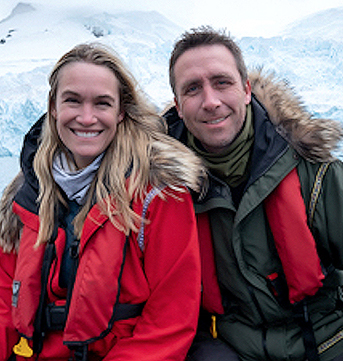
Article by Ashlan Cousteau and Philippe Cousteau Jr, Co-Founders of Seavoir Wellness.
Ashlan and Philippe Cousteau are ocean restorationists, filmmakers, and founders of SeaVoir and Voyacy Regen.