

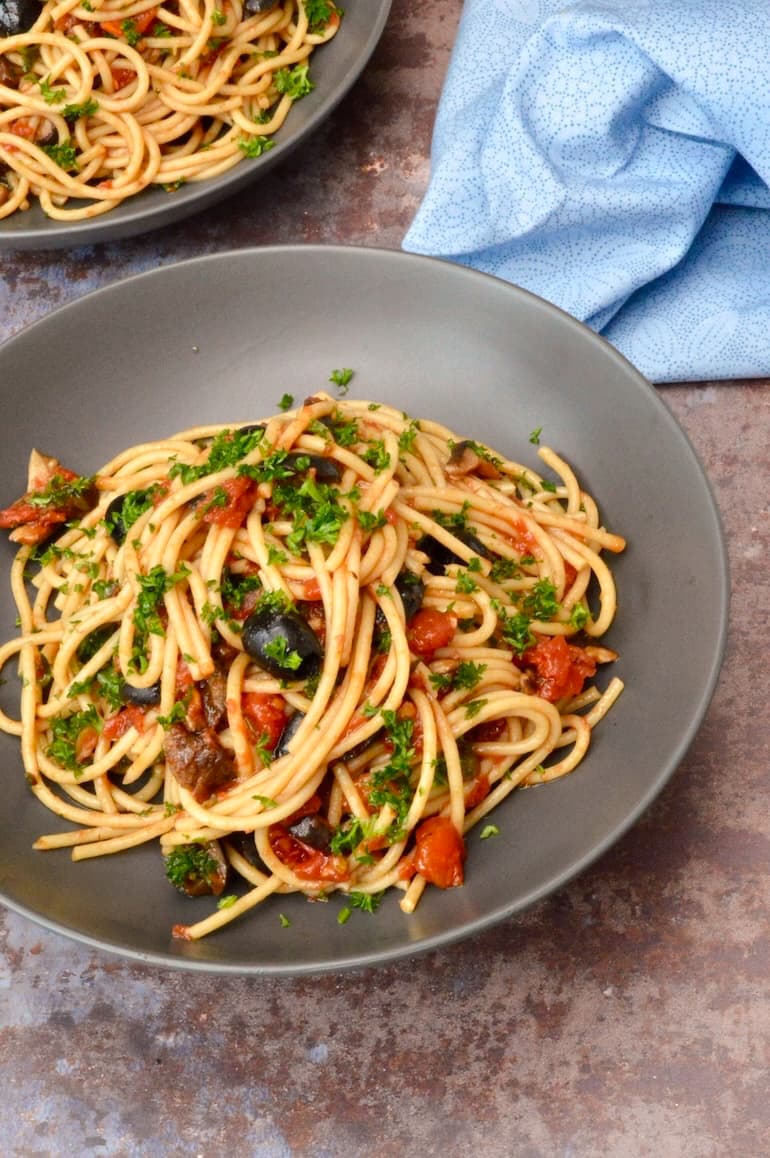
Rich, briny and undeniably umami led, this vegan pasta alla puttanesca is a delicious plant-based twist on the classic Neapolitan pasta recipe. The sauce is quick and easy to prepare. It’s made with classic Italian ingredients, namely tomatoes, olives, capers and garlic. But the requisite anchovies are replaced by tamari-fried shiitake mushrooms.
Dive Right In
What Is Puttanesca Sauce
Puttanesca is a popular tomato based sauce originating in Naples, Italy. It’s bold in flavour with lots of briny umami notes and a little bit of heat. Its main constituents are tomatoes, olives, capers, garlic and anchovies.

Traditionally, puttanesca sauce is served with spaghetti and is thus commonly known as spaghetti alla puttanesca. However, it works well with pretty much any large pasta shape.
There are various theories as to how puttanesca got its name. Its literal translation is “in the style of prostitutes”. One of the more popular stories is that back in the 1940s, Neapolitan brothel workers created it. Due to the sauce being made with pantry staples, they could make it quickly and easily in between clients.
Why You’ll Want To Make This Vegan Pasta Alla Puttanesca
- It delivers all the bold, salty, savoury flavours you expect from a classic puttanesca.
- Tamari-fried shiitake mushrooms add deep umami richness in place of anchovies.
- Quick and easy to make, so it’s ideal for busy weeknight dinners.
- Uses mostly pantry staples such as pasta, tomatoes, olives and capers.
- Rich tomato sauce coats the pasta beautifully for a comforting yet punchy meal.
- A great recipe for meat free Mondays or anyone looking to reduce consumption of animal products without sacrificing flavour.
- Easy to adapt with extra vegetables or your favourite pasta shape.
- Leftovers taste excellent the next day once the flavours have had time to develop.
Pasta Alla Puttanesca Without Anchovies
Whilst researching all the different ingredients you can use instead of anchovies for my post on anchovy substitutes, I realised I’d never made spaghetti alla puttanesca. Well that had to change. And it has.

Turns out, it’s actually quite similar in taste and ingredients to my Sicilian pasta salad, which is my favourite cold pasta dish. The basil is swapped for parsley, there’s the addition of capers and puttanesca is cooked, of course. But the rest is very similar. Both are extremely delicious.
As well as tasting good, it’s a really quick dish to put together. The sauce and pasta both cook at the same time, so the whole thing is pretty much done and dusted within twenty minutes. It’s the perfect plant-based meal for quick weeknight dinners. It’s also a great recipe to impress guests.
For the best eating experience, serve with some sort of greens to counteract all that salt and carbs, but you could easily add something along the lines of spinach, chard or even kale to the sauce instead.
Leftovers are actually really delicious. Just serve them at room temperature the next day. There’s no need to heat them up. The flavours have a chance to meld together. Just store in an airtight container in the fridge overnight and remove an hour or so before serving so the pasta has time to warm up.
Ingredients, Additions and Substitutions
Whatever its origin, puttanesca sauce is made with ingredients that are salted, brined or tinned. And it’s quite likely you’ll have most of them in your cupboard. The only fresh ingredients needed are parsley, garlic and mushrooms.

Unusually for an Italian pasta dish you don’t add any cheese. According to purists none is required as the dish is already full of umami and salty flavours. And in any case Italians believe that cheese just does’t pair well with fish.
Capers
Try to use salted capers rather than brined ones if you can. These retain more of their complex floral and umami notes. Brined capers, on the other hand, are generally firmer in texture and somewhat disguised in taste by the vinegar in which they sit.
Chilli
Because this dish is full of punchy flavours, hot chilli peppers are a welcome addition. They’re meant to provide a quiet warmth which runs through the sauce.
If you don’t like too much heat, just remove the seeds and membranes before chopping. Or just use a mild chilli instead. For just a touch of heat, use a whole dried chilli and fish it out just before serving.
Garlic
Fresh garlic is always best. For us though, last year’s harvest has run out and this year’s harvest isn’t yet in, so I used dried garlic granules instead. And that’s okay.
Mushrooms
You can use any well flavoured mushrooms you like for this recipe, but I favour shiitake mushrooms. They have a good umami flavour and a ‘meaty’ texture which lend themselves well to puttanesca sauce.
Porcini, oyster mushrooms and cremini are other good options.
Although it’s not the done thing to add Parmesan cheese to pasta alla puttanesca, you could swap an Italian hard cheese for the mushrooms if you’re vegetarian and like that idea. It’s certainly quicker and less faff too.
Olive Oil
Olive oil is a key ingredient in puttanesca. It lubricates the other ingredients, carries the flavour and binds them together. It also helps the sauce to cling to the pasta.
Use a good quality, medium intensity extra virgin olive oil. As the sauce’s flavours are robust, you need an oil that can stand up to them, but not one that overpowers everything else.
Olives
If you can get them, use Gaeta black olives. They’re the ones traditionally used for puttenesca. They go darkly purple when brined, but are black and crinkly when dried. Kalamata are a good alternative.
Having said that, go with whatever olives you have to hand or can easily get hold of. I used some black olives in brine from a fairly standard jar with no named variety. Not the best by any means, but they still worked well and gave the requisite savoury, briny and slightly bitter flavour.
Green are a last resort, but definitely better than no olives at all.
Pasta
Whole wheat spaghetti is ideal for pasta alla puttanesca. You get a dose of dietary fibre and slight nutty notes to complement the sauce. Spaghetti is also the traditional one to use for puttanesca. But it’s actually fine to use any large pasta shape of your choice.
Small pasta shapes such as orzo or orecchiette are not ideal as they get overwhelmed by the sauce’s rich chunky texture and flavour.
Tomatoes
Use well flavoured cooking tomatoes when in season or tinned plum ones out of season. Although it’s tempting to get cheap tins, you get what you pay for with canned tomatoes. The cheapest tend to be watery and not that flavoursome.
The theory goes that it’s best to buy whole plum tomatoes in tins rather than ready chopped as you then know what you’re getting. But I tend to plump for good quality chopped tomatoes as they’re just so much easier to deal with.
How To Cook Pasta Alla Puttanesca
Pasta alla puttanesca is one of the easiest pasta sauces to make. You don’t even need to chop an onion. From start to finish it should be on the table in about twenty minutes.
Please refer to the recipe card at the bottom of this post for cooking temperatures and quantities of ingredients used.

Step 1. Cook Pasta
Cook the pasta in plenty of boiling salted water until al dente. Follow the packet instructions for method and timing. Wholemeal pasta takes quite a bit longer to cook though, which is why you want to start cooking it straight away.
Step 2. Fry Mushrooms
Whilst the pasta is cooking, slice the mushrooms fairly thinly. Fry them in one tablespoon of extra virgin olive oil over a medium-high heat until they start to caramelise. Then add the tamari and stir fry for a further minute.
The mushrooms will quickly soak up the tamari and caramelise further. Don’t worry if some of them have stuck to the pan, they’ll come away when you add the other ingredients.
Step 3. Prepare Olives and Capers
Pit the olives if they’re not already pitted, then quarter them.

I’m usually fairly conservative with my use of salt in cooking as too much is not particularly good for those of us with high blood pressure. But this dish is big and bold in flavour and really needs to err on the salty side.
This means I don’t rinse the salt off my capers. I sort of shake as much as I can off without stressing. I then don’t need to add any additional salt other than the tamari. Salt is a very personal thing though so it’s entirely up to you if you follow my example or wash the salt off the capers prior to adding them to the sauce.
Step 4. Add Remaining Ingredients
Pour in the remaining olive oil then add the olives, capers, garlic and chilli and fry for a couple of minutes in order for the oil to pick up some of the flavour.
Add the chopped tomatoes, bring to the boil then lower the temperature and simmer gently with the lid on until everything is nicely combined and you have a thick sauce.
Top Tip – To skin fresh tomatoes, make a small cross in the bottom of each one with a sharp knife. Place them in a bowl and cover with boiling water. Leave for a minute than transfer to a bowl of cold water. As soon as they’re cool enough to handle, you should be able to slip the skins off easily. Or, if you don’t mind bits of skin floating around in the sauce, just leave them on.
Step 5. Add Pasta
Drain the pasta, reserving half a cup of the starchy cooking water. Transfer the pasta to the tomato sauce pan and toss together. Tongs are useful for this.


Top Tip – Transfer the pasta using tongs or a slotted spoon rather than draining, you’ll naturally transfer some of the pasta water along with it.
Simmer for a further minute, adding some of the reserved pasta water if needed. The sauce should cling to the pasta rather than run off it, but you don’t want it too thick either.
Top Tip – Starchy cooking water helps sauces cling to pasta.
Step 6. Serve Pasta
Whilst the pasta is finishing off, finely chop the parsley.


Remove the pan from the heat and stir in the black pepper and most of the parsley, reserving a little for garnish.

Divide the pasta into individual bowls and garnish with the reserved parsley.

Serve with a simple green salad or steamed greens, if liked.
Top Tip – If making the sauce for two people, make the amount in the recipe, but either freeze half of the sauce for another time or store it in the fridge. It will keep for two to three days.
Other Vegetarian Pasta Recipes You Might Like
Keep in Touch
Thank you for visiting Tin and Thyme. If you make this plant-based version of pasta alla puttanesca, I’d love to hear about it in the comments below. Do you have any recommendations or tips for making a vegan version?
Please rate the recipe too. And do tag me @choclette8 on Instagram with your images, I really enjoy seeing your take on my recipes.
For more delicious and nutritious recipes follow me on Twitter, Facebook, Instagram, Flipboard or Pinterest. And don’t forget to SUBSCRIBE to my weekly newsletter. Or why not join the conversation in our Healthy Vegetarian Whole Food Recipes Facebook Group?
If you’d like more vegan recipes, follow the link and you’ll find I have quite a lot of them. All delicious and nutritious, of course.
Choclette x
Vegan Spaghetti Alla Puttanesca. PIN IT.
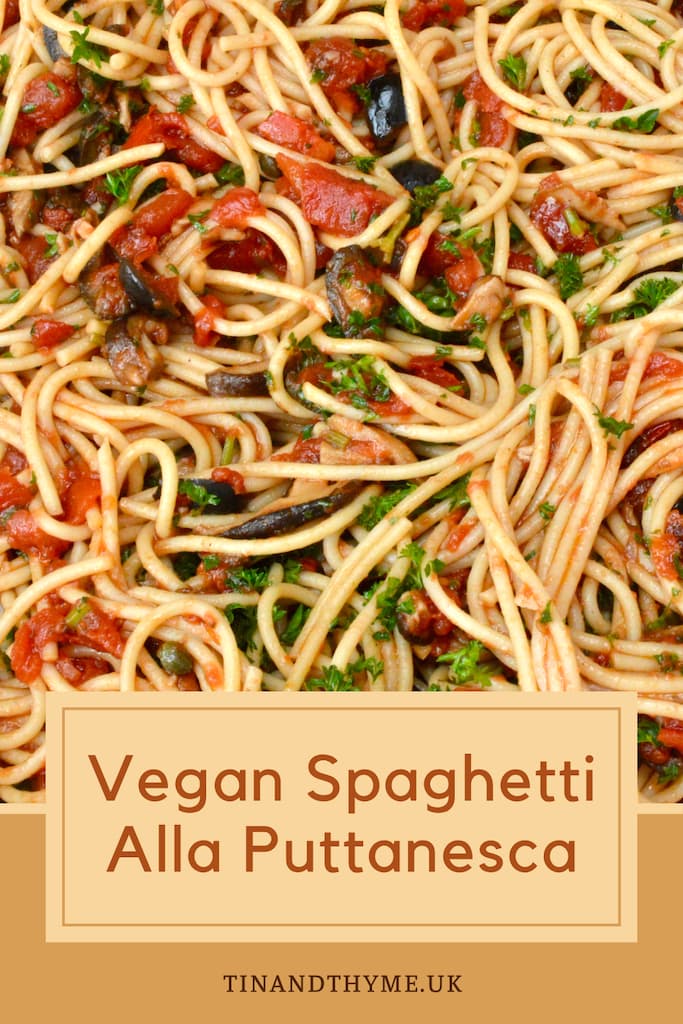
Vegan Pasta Alla Puttanesca
Rich, briny and undeniably umami led, this vegan pasta alla puttanesca is a delicious plant-based twist on the classic Neapolitan pasta recipe. The sauce is quick and easy to prepare. It’s made with classic Italian ingredients, namely tomatoes, olives, capers and garlic. But the requisite anchovies are replaced by tamari-fried shiitake mushrooms.
Toggle to keep screen awake
Servings: 4 people
Calories: 482kcal
- 320 g wholewheat spaghetti pasta or pasta of your choice
- 4 tbsp extra virgin olive oil
- 100 g shiitake mushrooms thinly sliced
- 1 tsp tamari (affiliate link)
- 125 g black olives pitted and quartered
- 1 tbsp capers rinsed of any salt
- 2 cloves garlic finely chopped
- 1 red chilli fresh or dried – finely chopped or 1 tsp chilli flakes
- 400 g tinned chopped tomatoes or use 500g fresh tomatoes – peeled and chopped
- good grinding of black pepper
- small bunch of parsley finely chopped
-
Cook the pasta in plenty of boiling salted water until al dante. Follow the packet instructions for timing. Wholemeal pasta takes quite a bit longer to cook though, which is why you want to start cooking it straight away.
320 g wholewheat spaghetti pasta
-
Whilst the pasta is cooking, fry the mushrooms in 1 tbsp of the oil over a medium-high heat for 3-4 minutes until starting to caramelise. Add the tamari and stir fry for a further minute.
100 g shiitake mushrooms, 1 tsp tamari (affiliate link)
-
Add the remaining 3 tbsp of oil together with the olives, capers, garlic and chilli and fry for 2 minutes.
125 g black olives, 1 tbsp capers, 2 cloves garlic, 1 red chilli
-
Add the tomatoes, bring to the boil then simmer gently for 10 minutes with the lid on until everything is nicely combined and you have a thick sauce.
400 g tinned chopped tomatoes
-
Drain the pasta, reserving half a cup of the starchy cooking water. Transfer the pasta to the tomato sauce pan and toss. Simmer for a further minute, adding some of the reserved pasta water if needed. The sauce should cling to the pasta rather than run off it, but you don’t want it too thick either.
-
Remove from the heat and stir in the pepper and most of the parsley, reserving a little for garnish.
good grinding of black pepper
-
Serve in individual bowls and garnish with the reserved parsley.
Calories: 482kcal | Carbohydrates: 69g | Protein: 14g | Fat: 20g | Saturated Fat: 3g | Polyunsaturated Fat: 2g | Monounsaturated Fat: 14g | Sodium: 780mg | Potassium: 503mg | Fiber: 3g | Sugar: 4g | Vitamin A: 435IU | Vitamin C: 27mg | Calcium: 87mg | Iron: 4mg